Age verification software: court orders birth proof checks

Read the full breakdown on court-ordered birth verification and identity assurance
The Allahabad High Court recently mandated that marriage registrars across Uttar Pradesh strictly verify documentary birth proof prior to certification, addressing widespread procedural failures where underage registrations were approved without validation. For developers, data engineers, and digital forensics investigators, this legal intervention highlights a fundamental systems vulnerability: manual, human-in-the-loop verification consistently breaks down when procedural adherence relies entirely on individual discretion rather than deterministic verification pipelines.
The Failure Mode of Passive Document Verification
The systemic breakdown identified in the court ruling stems from relying on passive document inspection. When an operator is handed a physical birth record or school certificate, the validation process is purely subjective. Without automated cryptographic signing, optical character recognition (OCR) parsing, or cross-document data validation, human review introduces catastrophic failure modes—ranging from operator fatigue to intentional non-compliance.
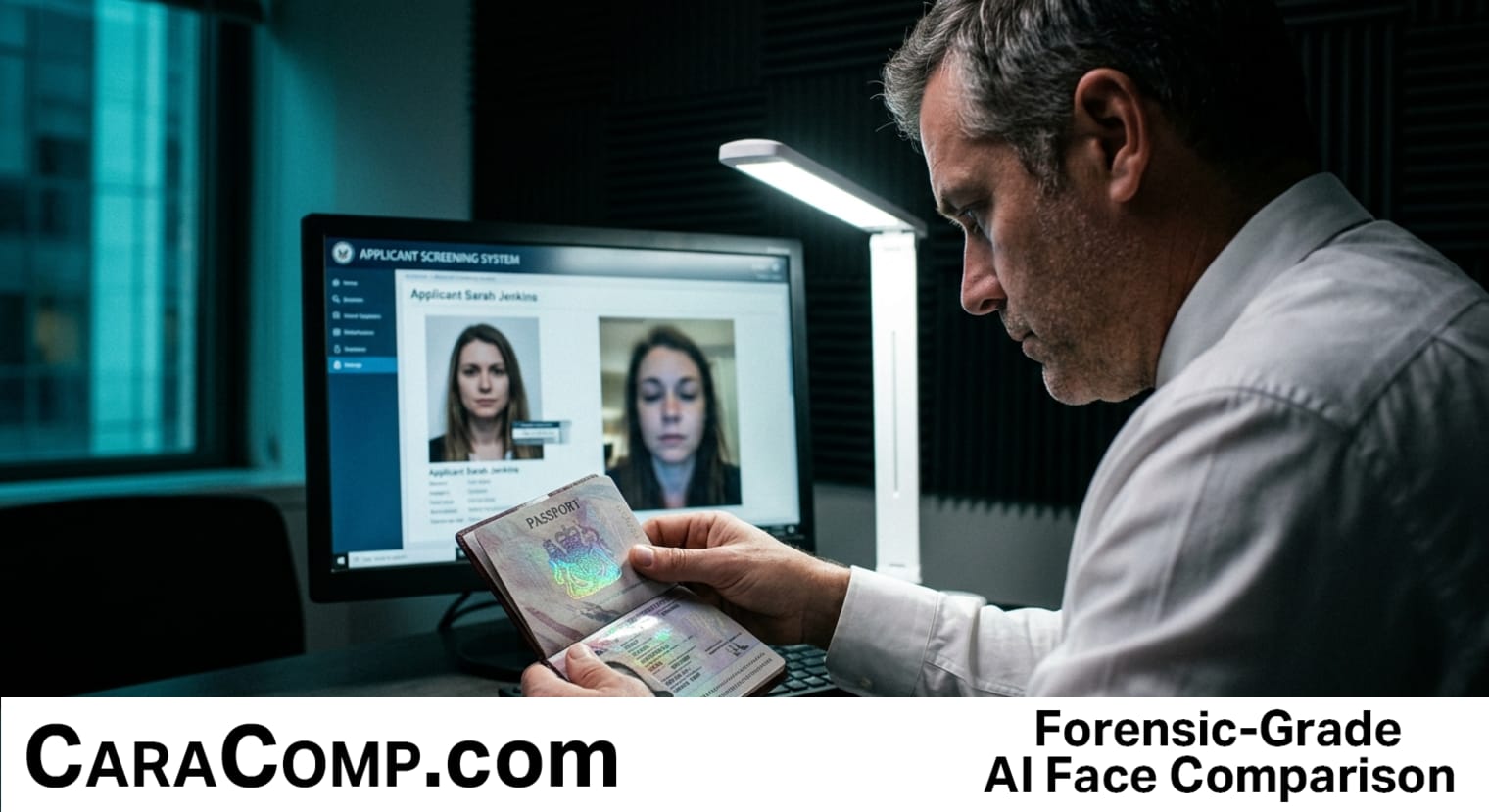
In modern software architecture, identity verification requires multi-modal pipelines that decouple validation from subjective review. A robust verification stack combines automated document parsing with deterministic 1:1 facial comparison. By extracting deep visual features and calculating vector embeddings from submitted identification photos, systems can compute precise Euclidean distance metrics against historical records. This mathematical approach transforms ambiguous document reviews into verifiable, reproducible similarity scores that establish ground truth across case files.
Replacing Clerical Discretion with Deterministic Comparison
Building reliable forensic and verification tooling requires shifting away from open-ended manual checks toward standardized algorithmic workflows:
- Feature Extraction: Deep convolutional networks and vision transformers extract high-dimensional latent vectors from document imagery.
- Metric Space Analysis: Systems calculate the Euclidean distance or cosine similarity between reference photos and identity records, generating objective confidence intervals.
- Automated Escalation: Instead of leaving edge cases to individual discretion, threshold-based logic automatically flags anomalies and routes disputed records to specialized oversight personnel.
This architectural shift is critical for private investigators, forensic researchers, and compliance teams handling complex case analysis. When manual photo comparison across large datasets takes hours and remains vulnerable to human error, automated batch processing using Euclidean distance analysis delivers high-precision results in seconds without requiring enterprise-level overhead.
The Engineering Path Forward for Identity Assurance
The judicial direction in Uttar Pradesh underscores that administrative mandates cannot succeed without robust verification infrastructure. Relying on paper checklists creates the illusion of compliance while leaving critical verification gaps open. As forensic investigators and software engineers build the next generation of case analysis workflows, the focus must remain on accessible, court-admissible algorithmic comparisons that eliminate human oversight errors.
As verification pipelines increasingly integrate automated document parsing with high-precision 1:1 facial comparison, how will engineering teams balance low-latency edge deployment with the cryptographic integrity required for legal admissibility?